Higher credence for the masses: From a Ted talk?

May 16, 2017
By

The Four Most Dangerous Words? A New Study Shows | Laura Arnold | TEDxPennsylvaniaAvenue I brought this link forward in some comments but wanted to promote it to a post as I think its important and I know many folks just do not read comments. As I once heard claimed in a talk on risk […] The post Higher credence for the masses: From a Ted talk? appeared first on…

Read more »

Slides on Association Rule Mining with R

May 16, 2017
By
Slides on Association Rule Mining with R

See my latest slides on Association Rule Mining with R at http://www.rdatamining.com/training/medascin/RDM-slides-association-rule-mining-with-r.pdf It is one of my tutorials on Machine Learning with R for the Melbourne Data Science Week on 1 June 2017. If you are interested, details can be … Continue reading →

Read more »

Taking Data Journalism Seriously

May 16, 2017
By

This is a bit of a followup to our recent review of “Everybody Lies.” While writing the review I searched the blog for mentions of Seth Stephens-Davidowitz, and I came across this post from last year, concerning a claim made by author J. D. Vance that “the middle part of America is more religious than […] The post Taking Data Journalism Seriously appeared first on Statistical Modeling, Causal Inference, and…

Read more »

Canadian winters in cold gray

May 16, 2017
By
Canadian winters in cold gray

I was looking at some Canadian data graphics while planning my talk in Vancouver this Thursday (you can register for the free talk here). I love the concept behind the following chart: Based on the forecasted temperature for 2015 (specifically...

Read more »

A Note on missing()

I had misunderstood the function missing() for several years. Originally I thought it only applies to an argument that does not have a default or user-specified value. For example, this is fairly easy to understand: f = function(x) { missing(x) } f() # should be TRUE One day I was surprised to find that this also returned TRUE: f = function(x = 1) { missing(x) } f() What?! x does…

Read more »

3 YEARS AGO (APRIL 2014): MEMORY LANE

May 15, 2017
By
3 YEARS AGO (APRIL 2014): MEMORY LANE

MONTHLY MEMORY LANE: 3 years ago: April 2014. I mark in red three posts from each month that seem most apt for general background on key issues in this blog, excluding those reblogged recently[1], and in green up to 4 others I’d recommend[2].  Posts that are part of a “unit” or a group count as one. For this month, I’ll include […]

Read more »

Book review: Everybody Lies by Seth Stephens-Davidowitz

May 15, 2017
By
Book review: Everybody Lies by Seth Stephens-Davidowitz

Kaiser Fung, founder of Principal Analytics Prep, discusses Seth Stephens-Davidowitz's new book, Everybody Lies

Read more »

What is needed to do good research (hint: it’s not just the avoidance of “too much weight given to small samples, a tendency to publish positive results and not negative results, and perhaps an unconscious bias from the researchers themselves”)

May 15, 2017
By

[cat picture] In a news article entitled, “No, Wearing Red Doesn’t Make You Hotter,” Dalmeet Singh Chawla recounts the story of yet another Psychological Science / PPNAS-style study (this one actually appeared back in 2008 in Journal of Personality and Social Psychology, the same prestigious journal which published Daryl Bem’s ESP study a couple years […] The post What is needed to do good research (hint: it’s not just the…

Read more »

Through time & space

May 15, 2017
By
Through time & space

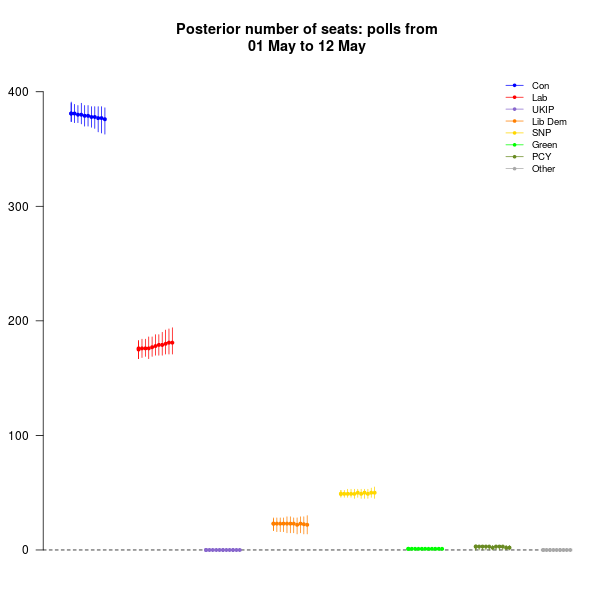
I've continued to fill in the data from the polls and re-run the model for the next UK general election. I think the dynamic element is interesting in principle, mainly because of how the data from the most recent polls could be weighed differently tha...

Read more »

Statistics in the Computer Age

May 15, 2017
By

Efron and Tibshirani's Computer Age Statistical Inference (CASI) is about as good as it gets. Just read it. (Yes, I generally gush about most work in the Efron, Hastie, Tibshirani, Brieman, Friedman, et al. tradition.  But there's good r...

Read more »

INTCK and INTNX: Two essential functions for computing intervals between dates in SAS

May 15, 2017
By
INTCK and INTNX: Two essential functions for computing intervals between dates in SAS

Last week I showed a timeline of living US presidents. The number of living presidents is constant during the time interval between inaugurations and deaths of presidents. The data was taken from a Wikipedia table (shown below) that shows the number of years and days between events. This article shows [...] The post INTCK and INTNX: Two essential functions for computing intervals between dates in SAS appeared first on The…

Read more »

What’s the deal with the YIMBYs?

May 15, 2017
By

This post is not by Andrew. It is by Phil. There’s at least one thing people in San Francisco seem to agree on: the rent is too damn high. The median rent is between about $3000 and $3500 per month…for a one-bedroom apartment. High-tech workers and upper-echelon businesspeople can afford a place, but baristas and […] The post What’s the deal with the YIMBYs? appeared first on Statistical Modeling, Causal…

Read more »

Should computer programming be a prerequisite for learning statistics?

May 14, 2017
By

[cat picture] This came up in a recent discussion thread, I can’t remember exactly where. A commenter pointed out, correctly, that you shouldn’t require computer programming as a prerequisite for a statistics course: there’s lots in statistics that can be learned without knowing how to program. Sure, if you can program you can do a […] The post Should computer programming be a prerequisite for learning statistics? appeared first on…

Read more »

Splines in Stan! (including priors that enforce smoothness)

May 13, 2017
By
Splines in Stan! (including priors that enforce smoothness)

Milad Kharratzadeh shares a new case study. This could be useful to a lot of people. And here’s the markdown file with every last bit of R and Stan code. Just for example, here’s the last section of the document, which shows how to simulate the data and fit the model graphed above: Location of […] The post Splines in Stan! (including priors that enforce smoothness) appeared first on Statistical…

Read more »

XXX

May 12, 2017
By

You gotta read this, including all the comments. It’s fascinating. (Link from Jkrideau.) The post XXX appeared first on Statistical Modeling, Causal Inference, and Social Science.

Read more »

Accounting for variation and uncertainty

May 12, 2017
By

[cat picture] Yesterday I gave a list of the questions they’re asking me when I speak at the Journal of Accounting Research Conference. All kidding aside, I think that a conference of accountants is the perfect setting for a discussion of of research integrity, as accounting is all about setting up institutions to enable trust. […] The post Accounting for variation and uncertainty appeared first on Statistical Modeling, Causal Inference,…

Read more »

Reality meets the DeLilloverse

May 11, 2017
By

From 2009: “They thought ASU’s brand was too strong to compete with. Incarnate Word is now part of the Communiversity @ Surprise, a newly opened one-stop learning center for higher education in the northwest Valley.” I guess my statistics textbooks probably read like parodies of statistics textbooks, so from that perspective it makes sense that […] The post Reality meets the DeLilloverse appeared first on Statistical Modeling, Causal Inference, and…

Read more »

Can you account for this?

May 11, 2017
By

I’m speaking (remotely) to a roomful of accountants tomorrow. Exciting, huh? Actually, I don’t know if they’re accountants. They’re “accounting researchers,” whatever that means. . . . The title they gave to my talk is “A statistician’s thoughts on registered reports.” There’s no abstract (and, of course, no slides) but they sent me this list […] The post Can you account for this? appeared first on Statistical Modeling, Causal Inference,…

Read more »

Mockery is the best medicine

May 11, 2017
By
Mockery is the best medicine

[cat picture] I’m usually not such a fan of twitter, but Jeff sent me this, from Andy Hall, and it’s just hilarious: The background is here. But Hall is missing a few key determinants of elections and political attitudes: subliminal smiley faces, college football, fat arms, and, of course, That Time of the Month. You […] The post Mockery is the best medicine appeared first on Statistical Modeling, Causal Inference,…

Read more »

How to interpret “p = .06” in situations where you really really want the treatment to work?

May 11, 2017
By
How to interpret “p = .06” in situations where you really really want the treatment to work?

We’ve spent a lot of time during the past few years discussing the difficulty of interpreting “p less than .05” results from noisy studies. Standard practice is to just take the point estimate and confidence interval, but this is in general wrong in that it overestimates effect size (type M error) and can get the […] The post How to interpret “p = .06” in situations where you really really…

Read more »

The Times agrees on privacy and kind of on fake news business

May 11, 2017
By

The New York Times Magazine has been publishing some pieces that directly relate to a couple of my blog posts. In this article, Amanda Hess noticed that "privacy became a commodity for the rich and powerful." This echoes my blog post on "Data is the next frontier of equal rights." Hess discussed the asymmetry and hypocrisy of the situation whereby the same businesses and business executives that are wantonly stripping…

Read more »

R in Insurance 2017 Programme online

May 11, 2017
By
R in Insurance 2017 Programme online

The programme for the 2017 R in Insurance conference in Paris has been published. Talks will discuss new ideas and research with the applications in life and general insurance, from network analysis, reserving, pricing to catastrophe modelling, followe...

Read more »

“P-hacking” and the intention-to-cheat effect

May 10, 2017
By

I’m a big fan of the work of Uri Simonsohn and his collaborators, but I don’t like the term “p-hacking” because it can be taken to imply an intention to cheat. The image of p-hacking is of a researcher trying test after test on the data until reaching the magic “p less than .05.” But, […] The post “P-hacking” and the intention-to-cheat effect appeared first on Statistical Modeling, Causal Inference,…

Read more »


Subscribe

Email:

  Subscribe