Reality meets the DeLilloverse

May 11, 2017
By

From 2009: “They thought ASU’s brand was too strong to compete with. Incarnate Word is now part of the Communiversity @ Surprise, a newly opened one-stop learning center for higher education in the northwest Valley.” I guess my statistics textbooks probably read like parodies of statistics textbooks, so from that perspective it makes sense that […] The post Reality meets the DeLilloverse appeared first on Statistical Modeling, Causal Inference, and…

Read more »

Can you account for this?

May 11, 2017
By

I’m speaking (remotely) to a roomful of accountants tomorrow. Exciting, huh? Actually, I don’t know if they’re accountants. They’re “accounting researchers,” whatever that means. . . . The title they gave to my talk is “A statistician’s thoughts on registered reports.” There’s no abstract (and, of course, no slides) but they sent me this list […] The post Can you account for this? appeared first on Statistical Modeling, Causal Inference,…

Read more »

Mockery is the best medicine

May 11, 2017
By
Mockery is the best medicine

[cat picture] I’m usually not such a fan of twitter, but Jeff sent me this, from Andy Hall, and it’s just hilarious: The background is here. But Hall is missing a few key determinants of elections and political attitudes: subliminal smiley faces, college football, fat arms, and, of course, That Time of the Month. You […] The post Mockery is the best medicine appeared first on Statistical Modeling, Causal Inference,…

Read more »

How to interpret “p = .06” in situations where you really really want the treatment to work?

May 11, 2017
By
How to interpret “p = .06” in situations where you really really want the treatment to work?

We’ve spent a lot of time during the past few years discussing the difficulty of interpreting “p less than .05” results from noisy studies. Standard practice is to just take the point estimate and confidence interval, but this is in general wrong in that it overestimates effect size (type M error) and can get the […] The post How to interpret “p = .06” in situations where you really really…

Read more »

The Times agrees on privacy and kind of on fake news business

May 11, 2017
By

The New York Times Magazine has been publishing some pieces that directly relate to a couple of my blog posts. In this article, Amanda Hess noticed that "privacy became a commodity for the rich and powerful." This echoes my blog post on "Data is the next frontier of equal rights." Hess discussed the asymmetry and hypocrisy of the situation whereby the same businesses and business executives that are wantonly stripping…

Read more »

R in Insurance 2017 Programme online

May 11, 2017
By
R in Insurance 2017 Programme online

The programme for the 2017 R in Insurance conference in Paris has been published. Talks will discuss new ideas and research with the applications in life and general insurance, from network analysis, reserving, pricing to catastrophe modelling, followe...

Read more »

“P-hacking” and the intention-to-cheat effect

May 10, 2017
By

I’m a big fan of the work of Uri Simonsohn and his collaborators, but I don’t like the term “p-hacking” because it can be taken to imply an intention to cheat. The image of p-hacking is of a researcher trying test after test on the data until reaching the magic “p less than .05.” But, […] The post “P-hacking” and the intention-to-cheat effect appeared first on Statistical Modeling, Causal Inference,…

Read more »

“Everybody Lies” by Seth Stephens-Davidowitz

May 10, 2017
By

Seth Stephens-Davidowitz sent me his new book on learning from data. As is just about always the case for this sort of book, I’m a natural reviewer but I’m not really the intended audience. That’s why I gave Dan Ariely’s book to Juli Simon Thomas to review; I thought her perspective would be more relevant […] The post “Everybody Lies” by Seth Stephens-Davidowitz appeared first on Statistical Modeling, Causal Inference,…

Read more »

A pretty good chart ruined by some naive analysis

May 10, 2017
By
A pretty good chart ruined by some naive analysis

The following chart showing wage gaps by gender among U.S. physicians was sent to me via Twitter: The original chart was published by the Stat News website (link). I am most curious about the source of the data. It apparently...

Read more »

Simulate lognormal data in SAS

May 10, 2017
By
Simulate lognormal data in SAS

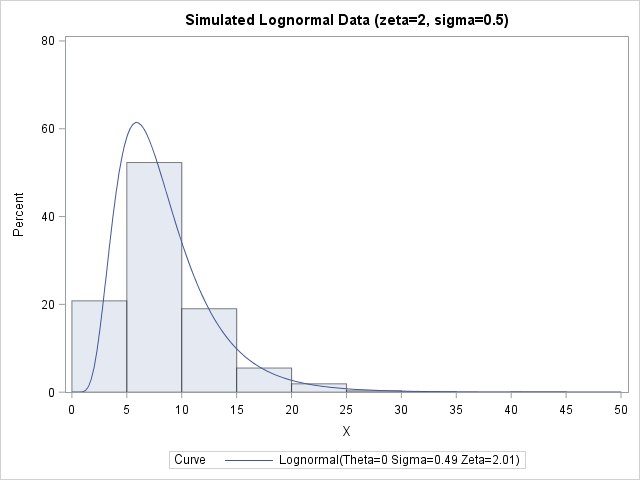
A SAS customer asked how to simulate data from a three-parameter lognormal distribution as specified in the PROC UNIVARIATE documentation. In particular, he wanted to incorporate a threshold parameter into the simulation. Simulating lognormal data is easy if you remember an important fact: if X is lognormally distributed, then Y=log(X) [...] The post Simulate lognormal data in SAS appeared first on The DO Loop.

Read more »

Honesty and transparency are not enough

May 9, 2017
By

[cat picture] From a recent article, Honesty and transparency are not enough: This point . . . is important for two reasons. First, consider the practical consequences for a researcher who eagerly accepts the message of ethical and practical values of sharing and openness, but does not learn about the importance of data quality. He […] The post Honesty and transparency are not enough appeared first on Statistical Modeling, Causal…

Read more »

Bounds Testing & ARDL Models – More From the EViews Team

May 9, 2017
By
Bounds Testing & ARDL Models – More From the EViews Team

The team at EViews has just released another post about ARDL modelling on their blog. This one is titled, "AutoRegressive Distributed Lag (ARDL) Estimation. Part 2 - Inference". This post is a follow-up to one that they wrote last month, and which I co...

Read more »

Assessing the evidential value of journals with p-curve, R-index, TIVA, etc: A comment on Motyl et al. (2017) with new data

May 9, 2017
By

Recently, Matt Motyl et al. (2017) posted a pre-print paper in which they contrasted the evidential value of several journals in two time periods (2003-2004 vs. 2013-2014). The paper sparked a lot of discussion in Facebook groups [1][2], blog posts com...

Read more »

“An anonymous tip”

May 9, 2017
By

[cat picture] I and a couple others received the following bizarre email: **’s research is just the tip of the iceberg. If you want to expose more serious flaws, look at research by his co-authors – ** at ** and ** at **. I won’t be checking this disposable e-mail address again. People send me […] The post “An anonymous tip” appeared first on Statistical Modeling, Causal Inference, and Social…

Read more »

Data on the Comey Effect

May 9, 2017
By
Data on the Comey Effect

There is currently a debate about whether or not the Comey letter flipped the election. Nate Cohn makes a convincing argument that the letter had little to no effect. Some time ago I looked at this myself and came to a similar conclusion. If anything, ...

Read more »

Video Introduction to Bayesian Data Analysis, Part 3: How to do Bayes?

May 8, 2017
By
Video Introduction to Bayesian Data Analysis, Part 3: How to do Bayes?

This is the last video of a three part introduction to Bayesian data analysis aimed at you who isn’t necessarily that well-versed in probability theory but that do know a little bit of programming. If you haven’t watched the other parts yet, I re...

Read more »

Riddle me this

May 8, 2017
By

[cat picture] Paul Alper writes: From Susan Perry’s article based on Paul Hacker’s BMJ article: https://www.minnpost.com/second-opinion/2017/04/investigative-report-uncovers-coca-colas-covert-attempts-influence-journalist In 2015, the University of Colorado had to shut down its nonprofit Global Energy Balance Network after the organization was exposed as being essentially a “scientific” front for its funder, Coca-Cola. The University of Colorado School of Medicine returned […] The post Riddle me this appeared first on Statistical Modeling, Causal Inference, and Social…

Read more »

It’s your fault when you use defaults

May 8, 2017
By
It’s your fault when you use defaults

The following chart showed up on my Twitter feed last week. It's a cautionary tale for using software defaults. At first glance, the stacking of years in a bar chart makes little sense. This is particularly so when there appears...

Read more »

Replicating Anomalies

May 8, 2017
By

I blogged a few weeks ago on "the file drawer problem".  In that vein, check out the interesting new paper below. I like their term "p-hacking". Random thought 1:  Note that reverse p-hacking can also occur, when an author wants low p-v...

Read more »

Timeline of living US presidents

May 8, 2017
By
Timeline of living US presidents

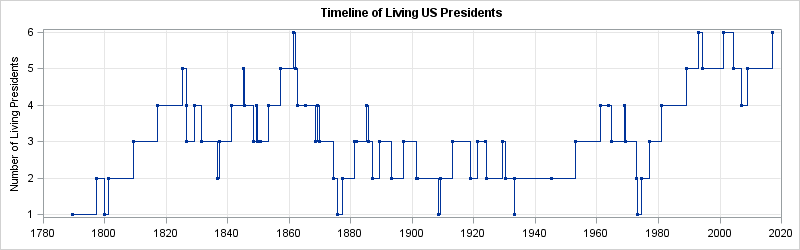
Quick! What is the next term in the numerical sequence 1, 2, 1, 2, 3, 4, 5, 4, 3, 4, ...? If you said '3', then you must be an American history expert, because that sequence represents the number of living US presidents beginning with Washington's inauguration on 30APR1789 and [...] The post Timeline of living US presidents appeared first on The DO Loop.

Read more »

What’s the difference between the French and U.S. presidential elections? Political parties.

May 8, 2017
By

Consider a national election with the following four major candidates, from right to left: – Populist far-right nativist – Religious conservative – Center-left technocrat – Populist anti-corporate leftist In the first round of the 2017 French presidential election, these four candidates received 21%, 20%, 24%, and 20%, respectively. In the United States, these candidates were […] The post What’s the difference between the French and U.S. presidential elections? Political parties.…

Read more »

AusDM 2017: submission deadline extended to 22 May

May 7, 2017
By
AusDM 2017: submission deadline extended to 22 May

AusDM 2017 will be a special event this year being held in conjunction with IJCAI in Melbourne. This is a tremendous opportunity to present data mining research from Australia to a wider audience, with collaborative arrangements with IJCAI to invite … Continue reading →

Read more »

Discussion with Lee Jussim and Simine Vazire on eminence, junk science, and blind reviewing

May 7, 2017
By

Lee Jussim pointed me to the recent article in Psychological Science by Joseph Simmons and Uri Simonsohn, expanding on their blog post on flaws in the notorious power pose article. Jussim then commented: I [Jussim] think that Cuddy/Fiske world is slowly shrinking. I think your “What Has Happened Here…” post was: 1. A bit premature […] The post Discussion with Lee Jussim and Simine Vazire on eminence, junk science, and…

Read more »


Subscribe

Email:

  Subscribe