Blog Archives

Clustering and sector strength

January 21, 2013
By
Clustering and sector strength

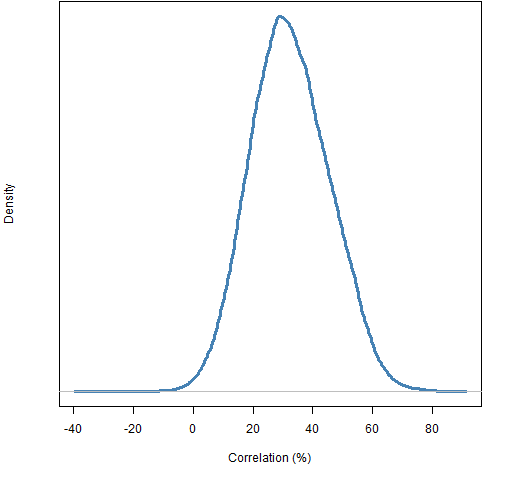
An exploration of the usefulness of sectors. Previously This subject was discussed in “S&P 500 sector strengths”. Idea Stocks are put into groups based on the sector that the company is considered to be in.  Cluster analysis is a statistical technique that finds groups.  If sectors really move together, then clustering should recover sectors.  Will … Continue reading →
Read more »

Market predictions for year 2013

January 7, 2013
By
Market predictions for year 2013

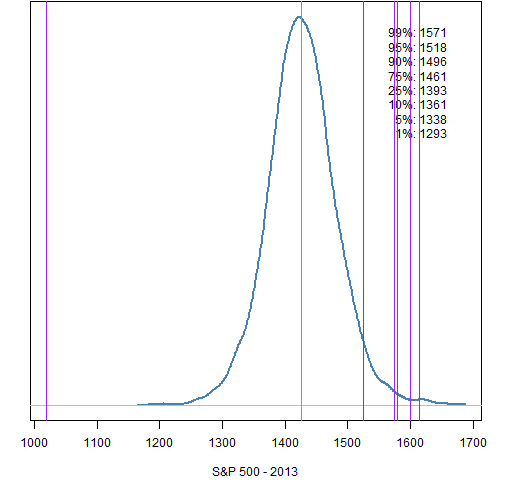
Calibrations of 2013 predictions for 18 equity indices — plus some publicly available predictions. Orientation The distributions are an attempt to see the variability if there were no market-driving news for the whole year. Another way of thinking: mentally moving the distribution to center on a prediction gives a sense of the variability of results … Continue reading →

Read more »

Miles of iles

December 24, 2012
By
Miles of iles

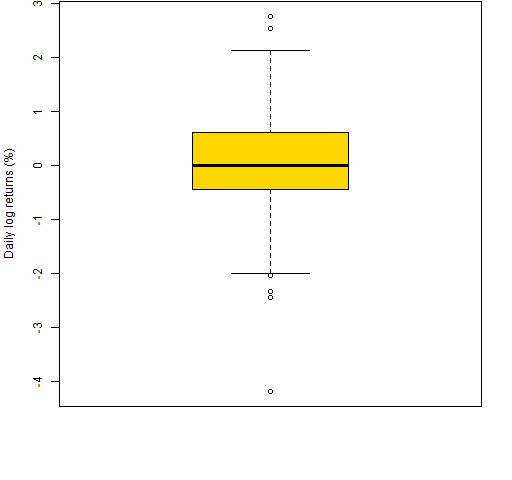
An explanation of quartiles, quintiles deciles, and boxplots. Previously “Again with variability of long-short decile tests” and its predecessor discusses using deciles but doesn’t say what they are. The *iles These are concepts that have to do with approximately equally sized groups created from sorted data. There are 4 groups with quartiles, 5 with quintiles … Continue reading →

Read more »

A look at historical Value at Risk

December 17, 2012
By
A look at historical Value at Risk

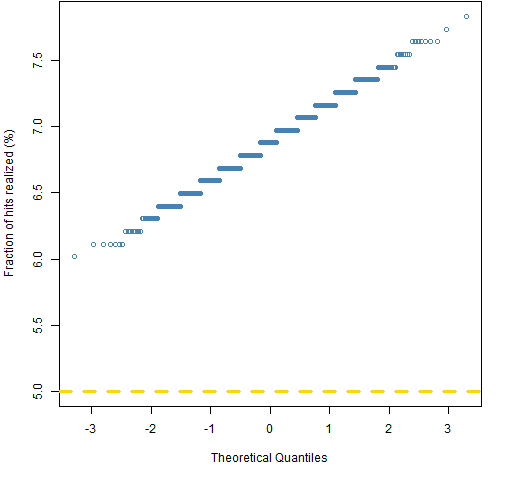
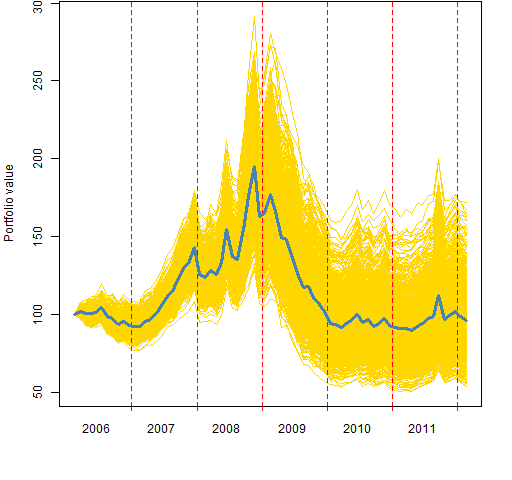
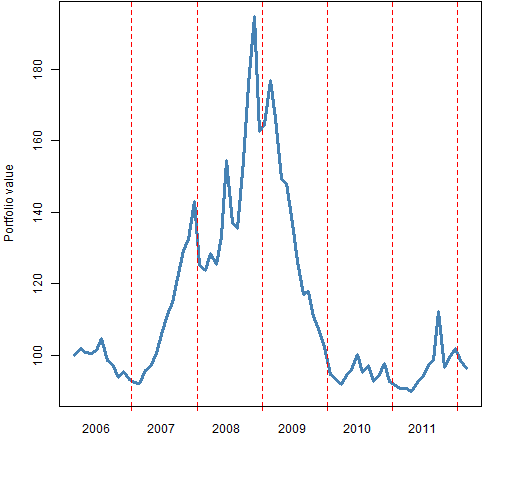
Historical Value at Risk (VaR) is very popular because it is easy and intuitive: use the empirical distribution of some specific number of past returns for the portfolio. Previously “The estimation of Value at Risk and Expected Shortfall” included an R function to estimate historical VaR. Generating portfolios A useful tool to explore risk models … Continue reading →

Read more »

garch and the Algorithmic Trading Conference

December 10, 2012
By

The Imperial College Algorithmic Trading Conference was Saturday. Talks Massoud Mussavian Massoud gave a great talk on “Algo Evolution”.  It started with a historical review of how trading used to be done “by hand”.  It culminated in a phylogenetic tree of trading algorithms.  There was an herbivore branch and a carnivore branch. Robert Macrae Robert … Continue reading →

Read more »

Again with variability of long-short decile tests

December 6, 2012
By
Again with variability of long-short decile tests

A simpler approach to producing the variability. Previously The post “Variability in long-short decile strategy tests” proposed a way of assessing the variability of strategy tests in which a long-short portfolio is created by equally weighting the top and bottom deciles. Improved idea Joe Mezrich suggests maintaining equal weights but bootstrapping the assets within the … Continue reading →

Read more »

Variability in long-short decile strategy tests

December 3, 2012
By
Variability in long-short decile strategy tests

How to capture return variability when testing strategies with long-short deciles. Traditional practice Question: Does variable X have predictive power for our universe of assets? A common scheme of quants to answer the question is to form a series of portfolios over time.  The portfolio at each time point: is long the equal weighting of … Continue reading →

Read more »

Discovering the quality of portfolio decisions

November 26, 2012
By
Discovering the quality of portfolio decisions

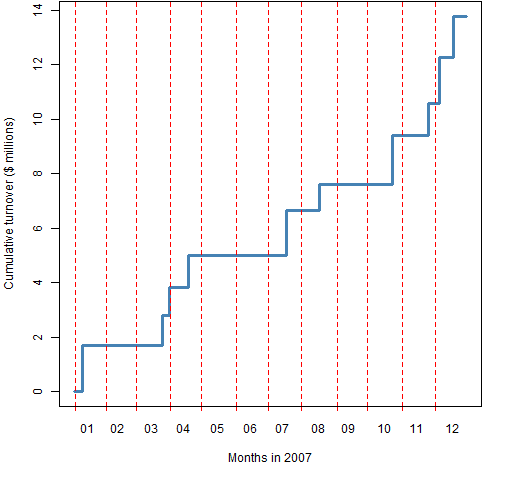
Performance analysis of an example portfolio. The portfolio We explore a particular portfolio during 2007.  It invests in S&P 500 stocks and starts the year with a value of $10 million.  Initially there are 50 names in the portfolio.  It also ends the year with 50 names but has up to 53 names during the … Continue reading →

Read more »

Upcoming events

November 20, 2012
By

New Events  Thalesians (London) 2012 November 21: Isabel Ehrlich on “Basket Options with Smile”. Abstract: Due to the distinct lack of models for basket options that remain consistent with the market smile we look at approximations that are able to accurately replicate the volatility smile. Notably we turn to the use of an Edgeworth series … Continue reading →

Read more »

The estimation of Value at Risk and Expected Shortfall

November 19, 2012
By

An introduction to estimating Value at Risk and Expected Shortfall, and some hints for doing it with R. Previously “The basics of Value at Risk and Expected Shortfall” provides an introduction to the subject. Starting ingredients Value at Risk (VaR) and Expected Shortfall (ES) are always about a portfolio. There are two basic ingredients that … Continue reading →

Read more »

Subscribe

Email:

  Subscribe