
(This article was originally published at Statistical Modeling, Causal Inference, and Social Science, and syndicated at StatsBlogs.)
Blake McShane writes:
I wanted to write to you about something related to your ongoing posts on replication in psychology as well as your recent post the ASA statement on p-values. In addition to the many problems you and others have documented with the p-value as a measure of evidence (both those computed “honestly” and those computed after fishing, the garden of forking paths, etc.), another problem seems to be that academic researchers across the biomedical and social sciences genuinely interpret them quite poorly.
In a forthcoming paper, my colleague David Gal and I survey top academics across a wide variety of fields including the editorial board of Psychological Science and authors of papers published in the New England Journal of Medicine, the American Economic Review, and other top journals. We show:
[1] Researchers interpret p-values dichotomously (i.e., focus only on whether p is below or above 0.05).
[2] They fixate on them even when they are irrelevant (e.g., when asked about descriptive statistics).
[3] These findings apply to likelihood judgments about what might happen to future subjects as well as to choices made based on the data.
We also show they ignore the magnitudes of effect sizes.In case you have any interest, I am attaching the paper. Unfortunately, our data is presented in tabular format due to an insistent AE; thus, I am also attaching our supplement which presents the data graphically.
And here’s their key finding:
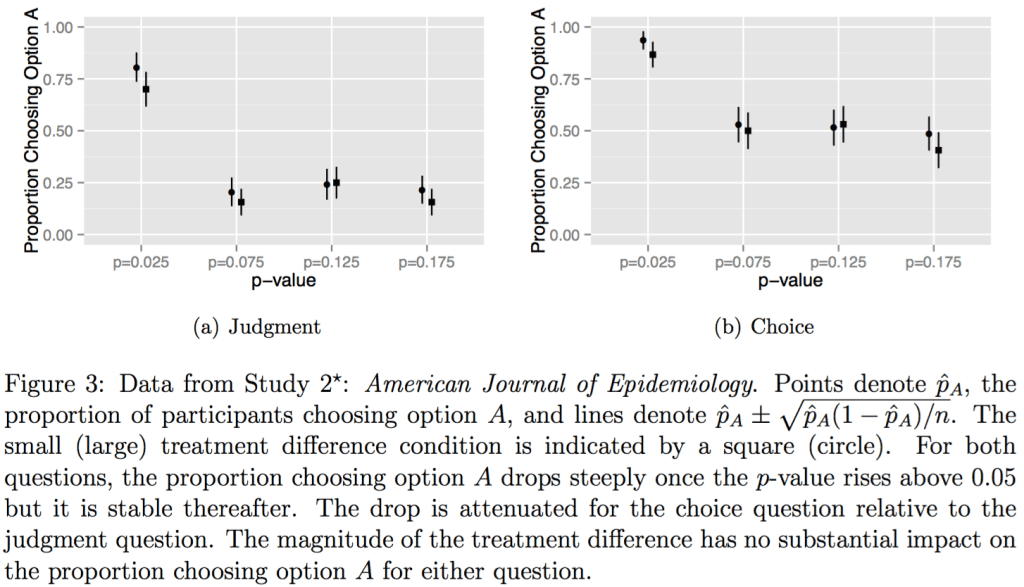
Bad news. I’m sure researchers would also misinterpret Bayesian inferences to the extent that they are being used in a null hypothesis significance testing framework. I think p-values are particularly bad because, either they’re being used to make (generally meaningless) claims about hypotheses being true or false, or they’re being used as an indirect estimation tool, in which case they have that horrible nonlinear transformation that makes them so hard to interpret (the difference between significant and non-significant not being itself statistically significant and all that, which is part of the bigger problem that these numbers are just about impossible to interpret in the (real-world) scenario in which the null hypothesis is not precisely true.
The post More evidence that even top researchers routinely misinterpret p-values appeared first on Statistical Modeling, Causal Inference, and Social Science.
Please comment on the article here: Statistical Modeling, Causal Inference, and Social Science
