Posts Tagged ‘ sql ’

Store multiple strings of text as a macro variable in SAS with PROC SQL and the INTO statement

Store multiple strings of text as a macro variable in SAS with PROC SQL and the INTO statement

I often need to work with many variables at a time in SAS, but I don’t like to type all of their names manually – not only is it messy to read, it also induces errors in transcription, even when copying and pasting.  I recently learned of an elegant and efficient way to store multiple […]

Read more »

Use a Join Controller to Document Your Work

June 13, 2017
By
Use a Join Controller to Document Your Work

This note describes a useful replyr tool we call a "join controller" (and is part of our "R and Big Data" series, please see here for the introduction, and here for one our big data courses). When working on real world predictive modeling tasks in production, the ability to join data and document how you … Continue reading Use a Join Controller to Document Your Work

Read more »

replyr: Get a Grip on Big Data in R

March 5, 2017
By
replyr: Get a Grip on Big Data in R

replyr is an R package that contains extensions, adaptions, and work-arounds to make remote R dplyr data sources (including big data systems such as Spark) behave more like local data. This allows the analyst to more easily develop and debug procedures that simultaneously work on a variety of data services (in-memory data.frame, SQLite, PostgreSQL, and … Continue reading replyr: Get a Grip on Big Data in R

Read more »

Organize your data manipulation in terms of “grouped ordered apply”

December 15, 2016
By
Organize your data manipulation in terms of “grouped ordered apply”

Consider the common following problem: compute for a data set (say the infamous iris example data set) per-group ranks. Suppose we want the rank of iris Sepal.Lengths on a per-Species basis. Frankly this is an “ugh” problem for many analysts: it involves all at the same time grouping, ordering, and window functions. It also is … Continue reading Organize your data manipulation in terms of “grouped ordered apply”

Read more »

The case for index-free data manipulation

December 10, 2016
By
The case for index-free data manipulation

Statisticians and data scientists want a neat world where data is arranged in a table such that every row is an observation or instance, and every column is a variable or measurement. Getting to this state of “ready to model format” (often called a denormalized form by relational algebra types) often requires quite a bit … Continue reading The case for index-free data manipulation

Read more »

An Achievement on Stack Overflow

August 26, 2014
By
An Achievement on Stack Overflow

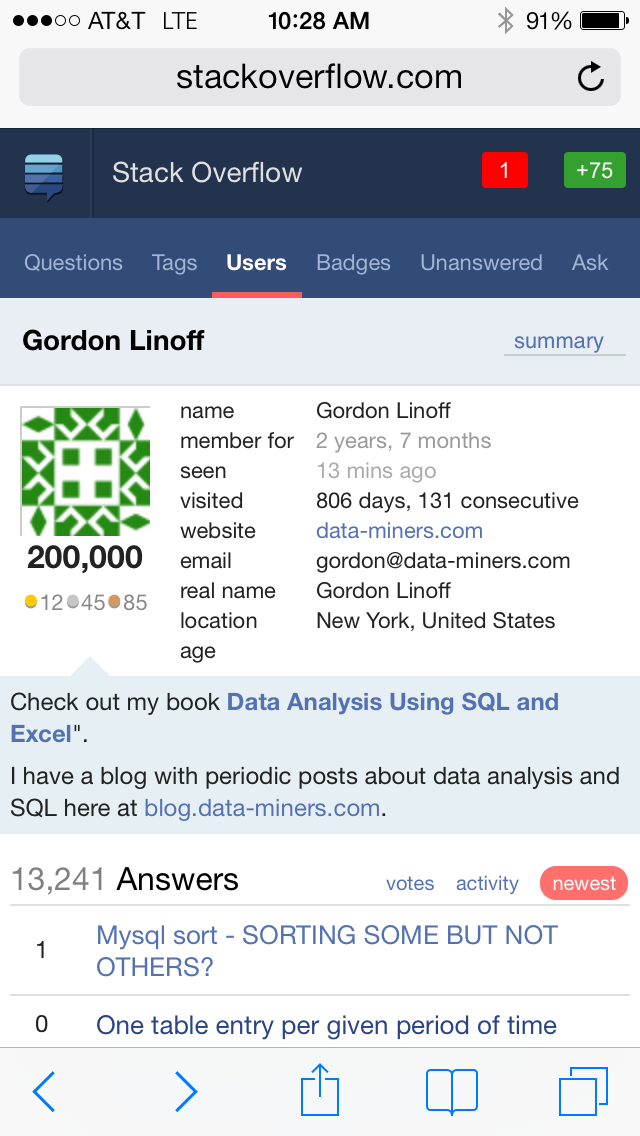
Last Friday (August 22nd), I achieved a milestone on Stack Overflow, a computing question-and-answer site, by hitting 200,000 points.  So far this year, I have also earned more points than anyone, a testament to my obsession with the site (you can...

Read more »

Loading IP Test Data Into Postgres

May 31, 2014
By
Loading IP Test Data Into Postgres

Recently, I was trolling around the internet looking for some IP address data to play with.  Fortunately, I stumbled across MaxMind's Geolite Database, which is available for free.    All I have to do is include this notice:This product ...

Read more »

Three SQL Constructs You Can Forget About

March 25, 2014
By

SQL is a very powerful language, which could, of course, be made even more powerful and useful.  This post discusses three features of the language -- ANSI standard features -- that seem not only unnecessary but downright detrimental.  That i...

Read more »

Big Data and SQL

March 20, 2014
By

I happen to think that SQL is a very viable option for analyzing big data.  I was thinking about this when I a book review recently:For instance, Siegel reports, people who buy small felt pads that adhere to the bottom of chair legs (to protect th...

Read more »

Taking a Random Sample on Amazon Redshift

February 26, 2014
By

Recently, I was approached by Vicky whom I'm working with at a client, to help with a particular problem.  She wanted to calculate page view summaries for a random sample of visitors from a table containing about a billion page views.  This i...

Read more »


Subscribe

Email:

  Subscribe