
I wasn't going to post on this ... but couldn't resist. A recent QJEP paper reports suspicious patterns in p values across three psychology journals. This has been blogged elsewhere (see here and here), so I haven't got too much to add. Although ...

I wasn't going to post on this ... but couldn't resist. A recent QJEP paper reports suspicious patterns in p values across three psychology journals. This has been blogged elsewhere (see here and here), so I haven't got too much to add. Although ...
I wasn't going to post on this ... but couldn't resist. A recent QJEP paper reports suspicious patterns in p values across three psychology journals.This has been blogged elsewhere (see here and here), so I haven't got too much to add. Although I ...
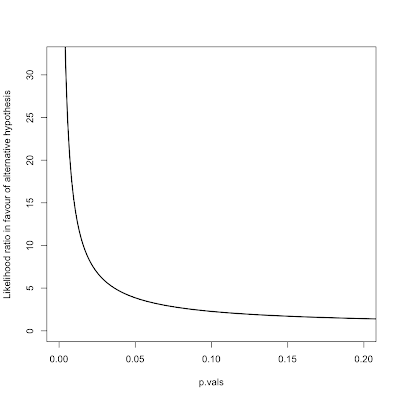
I've been thinking about p values quite a bit recently - prompted by a other bloggers and by some journal work. One interesting phenomenon in this area is the cliff effect: a supposed abrupt shift in researchers' confidence in an effect when moving fro...
I finally found some time to take a closer look at p curves. I haven't had a chance to follow-up my simulations (and probably won't for a few weeks if not months), but I have had time to think through the ideas the p curve approach raises based on some...
I have finally got around to posting the R code for my p curve simulation. Those familiar with R will realize how crude it is (I've been caught up with other urgent stuff and had no time to explore further).You are welcome to play with (and improve!) t...

Psych your mind has an interesting blog post on using p curves to detect dodgy stats in a a volume of published work (e.g., for a researcher or journal). The idea apparently comes from Uri Simonsohn (one of the authors of a recent paper on dodgy s...
