Posts Tagged ‘ kaggle ’

From Whale Calls to Dark Matter: Competitive Data Science with R and Python

July 12, 2013
By
From Whale Calls to Dark Matter: Competitive Data Science with R and Python

Back in June I gave a fun talk at Montreal Python on some of my dabbling in the competitive data science scene. The good people at Savior-fair Linux recorded the talk and have edited it all together into a pretty slick video. If you can spare twenty-minutes or so, have a look. If you want […]

Read more »

Dark matter top 10, but an hour too late

December 17, 2012
By
Dark matter top 10, but an hour too late

Well, that’s embarrassing. A little tweak to my dark matter model resulted in a leaderboard score in the top 10. The only problem is that the contest closed about an hour ago. I ran this final prediction earlier today but then simply forgot to go back to it and submit!! On the bright side, I […]

Read more »

Sunday data/statistics link roundup (12/2/12)

December 2, 2012
By

An interview with Anthony Goldbloom, CEO of Kaggle. I’m not sure I’d agree with the characterization that all data scientists are: creative, curious, and competitive and certainly those characteristics aren’t unique to data scientists. And I didn’t know this: “We … Continue reading →

Read more »

Simulating weak gravitational lensing

November 24, 2012
By
Simulating weak gravitational lensing

In the search for dark matter, I have been having mixed success. It seems that locating DM in single halo skies is a fairly straightforward problem. However, when there are more than one halo, things get quite a bit trickier. As I have advocated many times before, including here and here, simulation can provide deep […]

Read more »

Dark matter benchmarks: All over the map

October 14, 2012
By
Dark matter benchmarks: All over the map

The three benchmark algorithms for predicting the location of dark matter halos are, for the most part, all over the map. Most of the test skies look something like this: There are, however, some skies with rather strong halo signals that get a decent amount of agreement: The Lenstool MLE algorithm is the current state

Read more »

Observing Dark Worlds – Visualizing dark matter’s distorting effect on galaxies

October 13, 2012
By
Observing Dark Worlds – Visualizing dark matter’s distorting effect on galaxies

Some people like to do crossword puzzles. I like to do machine learning puzzles. Lucky for me, a new contest was just posted yesterday on Kaggle. So naturally, my lazy Saturday was spent getting elbow deep into the data. The training set consists of a series of ‘skies’, each containing a bunch of galaxies. Normally,

Read more »

The essence of a handwritten digit

August 14, 2012
By
The essence of a handwritten digit

If you haven’t yet discovered the competitive machine learning site kaggle.com, please do so now. I’ll wait. Great – so, you checked it out, fell in love and have made it back. I recently downloaded the data for the getting started competition. It consists of 42000 labelled images (28×28) of hand written digits 0-9. The

Read more »

How Many Data Scientists Are There?

August 9, 2012
By
How Many Data Scientists Are There?

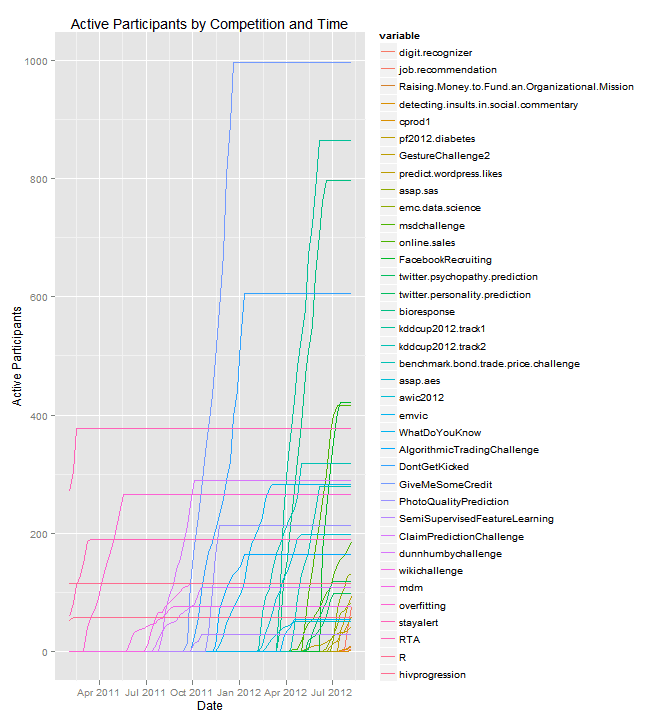
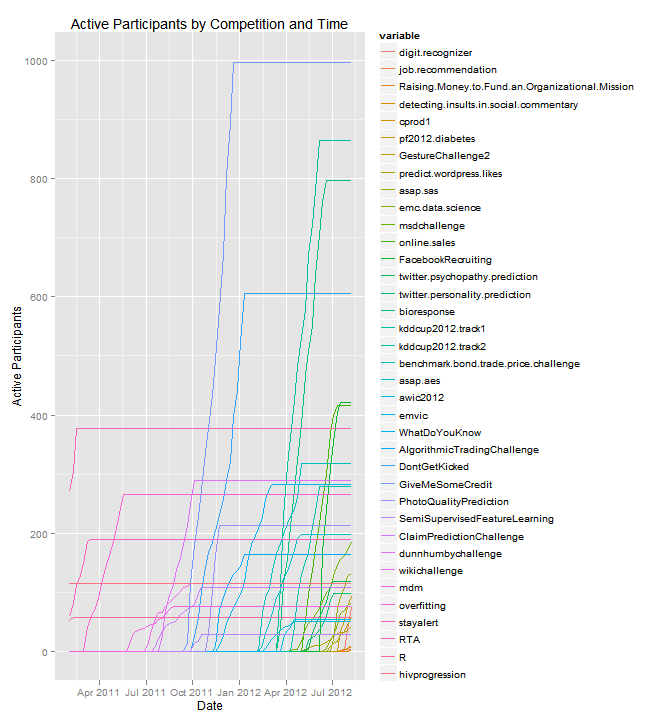
I’ve seen a lot of articles lately about “Big Data” and the looming “talent gap.” This article from the Wall Street Journal is a good example. It cites a McKinsey estimate that states that we will need 1.5 million more Continue reading →

Read more »

How Many Data Scientists Are There?

August 9, 2012
By
How Many Data Scientists Are There?

How Many Data Scientists Are There?I've seen a lot of articles lately about “Big Data” and the looming “talent gap.” This article from the Wall Street Journal is a good example. It cites a McKinsey estimate that states that we will need 1.5 m...

Read more »

How Many Data Scientists Are There?

August 9, 2012
By
How Many Data Scientists Are There?

How Many Data Scientists Are There?I've seen a lot of articles lately about “Big Data” and the looming “talent gap.” This article from the Wall Street Journal is a good example. It cites a McKinsey estimate that states that we will need 1.5 million more managers and analysts who are conversant with “big data.” Of course, some of this is the media latching on the the next “big thing” (data),…

Read more »


Subscribe

Email:

  Subscribe