
(This article was originally published at Doing Bayesian Data Analysis, and syndicated at StatsBlogs.)
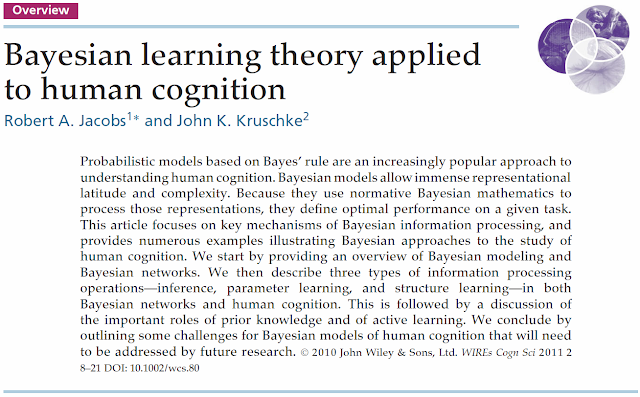
“The brain is a guessing machine [i.e., Bayesian inference engine - JKK], trying at each moment of time to guess what is out there,” says computational neuroscientist Peggy Seriès. Guesses just slightly off — like mistaking a smile for a smirk — rarely cause harm. But guessing gone seriously awry may play a part in mental illnesses such as schizophrenia, autism and even anxiety disorders, Seriès and other neuroscientists suspect. They say that a mathematical expression known as Bayes’ theorem — which quantifies how prior expectations can be combined with current evidence — may provide novel insights into pernicious mental problems that have so far defied explanation.For a tutorial about Bayesian models of perception and cognition, see Bayesian learning theory applied to human cognition.
Note that Bayesian modeling of data is a richly valuable approach regardless of whether any particular Bayesian model of mind is accurate. See this brief blog post for the distinction between (Bayesian) descriptive models of data, psychometric models, and models of mind.

Please comment on the article here: Doing Bayesian Data Analysis
